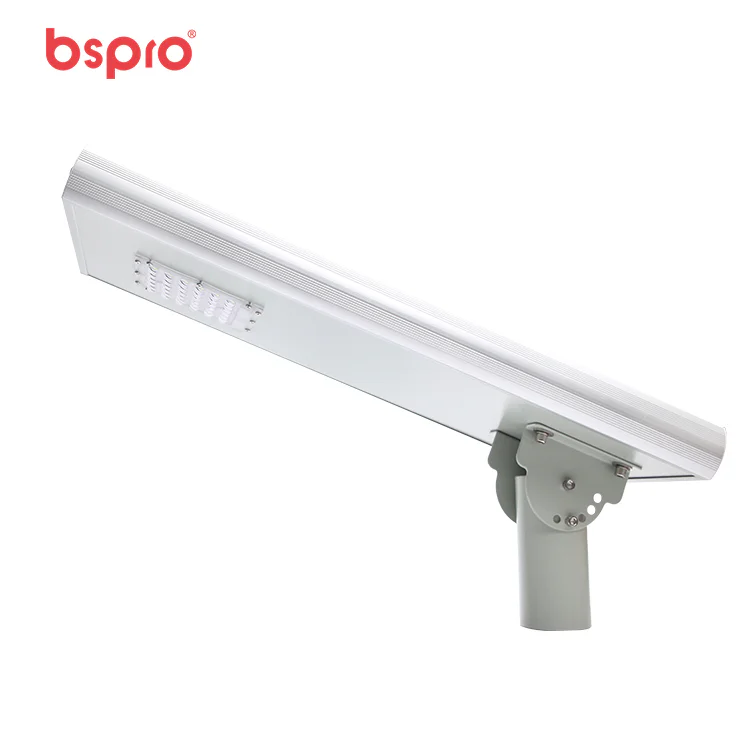
A solar flood light throws a wide, bright beam where you need it without trenching power to the site. For yards, facades, billboards, and job sites across Asia, Africa, and Latin America, that off-grid freedom is the whole point. This guide covers how to match wattage, IP rating, and remote control to your actual site.
In this guide:
- What a solar flood light is (and isn’t)
- MD-PT77 series at a glance
- How to choose the right wattage
- How many lumens do you need?
- Specs that decide reliability
- Installation: getting the most from the panel
- Solar vs wired flood light
- Common buying mistakes
- Hot, dusty, and coastal climates
- Maintenance and battery life
- Procurement checklist
- FAQ
What a solar flood light is (and isn’t)
A solar flood light pairs a PV panel, a battery, an LED array, and a charge controller in one self-powered unit. Unlike a solar street light, it isn’t built to mount on a tall pole and light a roadway — it’s meant to wash a wall, a yard, a sign, or a work area with broad, angled light. No mains cable, no electrician, just sun in and light out.

MD-PT77 series at a glance
The MD-PT77 line covers three output tiers, all sharing the same outdoor-rated build with remote control:
| Model | Power | LED | Luminous | Body size (mm) | Solar panel size (mm) |
|---|---|---|---|---|---|
| MD-PT77-200W | 5V 10W | SMD 2835, 144PCS | 1000LM | 275×230×70 | 205×330×15 |
| MD-PT77-300W | 5V 15W | SMD 2835, 240PCS | 1300LM | 352×270×70 | 290×350×15 |
| MD-PT77-400W | 5V 20W | SMD 2835, 360PCS | 1900LM | 380×315×70 | 390×310×15 |

How to choose the right wattage
- Small yard / garden / shop sign: the 200W-tier (1000LM) is plenty for a wall wash or a pathway.
- Facade / courtyard / billboard: the 300W-tier (1300LM) covers a wider spread without glare.
- Worksite / large compound / parking row: the 400W-tier (1900LM) holds up over distance and against ambient light.
Judge brightness by lumens, not the model number — a well-built 200W-tier unit can outshine a cheap higher-watt claim.
How many lumens do you need?
Model names on solar flood lights are marketing numbers — the honest comparison is lumens. A quick way to size a unit for your site:
- Measure the area. Length × width in square meters — a tape measure is enough.
- Pick a target by job. As a general outdoor benchmark, ambient area lighting sits around 20–50 lm/m², wall and facade washing runs brighter at roughly 50–150 lm/m², and detailed work areas need more still. Brighter is not automatically better — glare wastes battery and annoys neighbors.
- Multiply. Area × target gives the lumen band you need, then pick the tier that covers it.
Example: a 20 m² courtyard at ambient level needs roughly 400–1,000 lm depending on how bright you like it — the 200W tier (1000LM) sits at the top of that band. A 60 m² parking row lands nearer 1,200–3,000 lm, which is where the 400W tier (1900LM) starts to make sense — often as two units spaced apart rather than one oversized one.
Two smaller units spaced apart usually beat one big unit: more even coverage, fewer dark corners, and a spare if one fails.
Specs that decide reliability
The model is only half the story. Whatever you specify, these separate a unit that lasts from one that fails:
- IP rating: the MD-PT77 is built IP65 outdoor waterproof — check the rating against rain, dust, and coastal sites.
- LED type: SMD 2835 chips (used across the MD-PT77 line) are the commercial-grade choice for efficiency and life.
- Remote control: the whole line ships with remote control for on/off, dimming, and timing without climbing a ladder.
- Charge controller: look for protected charging so the battery survives cloudy stretches.

Installation: getting the most from the panel
A solar flood light is easy to mount — but where and how you mount it decides how well it charges. Three things matter more than the tools:
- Sun exposure first. Keep the panel out of shade from trees, walls, and rooflines. Even partial shading cuts charging for the entire day, not just the shaded hours.
- Tilt the panel. An angled panel sheds rain and dust and catches more sun than one mounted flat. As a rough rule, tilt it close to your site’s latitude, a little steeper in winter.
- Plan the cable route. The panel and lamp connect by cable — check the reach before drilling, and keep connectors off the ground and out of standing water.
Panel orientation by hemisphere
Sites in the northern hemisphere angle panels toward the south; southern-hemisphere sites face them north. Close to the equator, a gentler tilt with clear exposure through the day usually works well.
Where a solar flood light beats a wired one
- No trenching: light a fence line or a remote gate without running cable.
- Rentable / movable: shift it as the site changes — a billboard, a stall, a temporary lot.
- Lower install cost: no electrician, no permit, no monthly draw.
Side by side:
| Factor | Solar flood light | Wired flood light |
|---|---|---|
| Installation | Bolt it up — no trenching, no electrician | Cable runs, conduit, an electrician |
| Running cost | None — the sun charges it | Electricity draw every night |
| Mobility | Move it as the site changes | Fixed where the cable ends |
| Grid outage | Keeps working through blackouts | Dark during power cuts |
| Brightness ceiling | Limited by panel and battery size | Near-unlimited on mains power |
That last row is the honest trade-off: for very high-output, all-night industrial lighting, wired still wins. For yards, facades, billboards, gates, and mid-size work areas — especially where the grid is unreliable — solar usually wins on total cost and freedom of placement.

Common buying mistakes
- Buying by the watt number. Model names often quote big wattages while the panel and battery tell the real story. Compare lumens and panel size, not the label.
- Mounting the panel in shade. The most common reason a “weak” solar light is weak. A panel that sees sun for half the day charges for half the day.
- Undersizing for cloudy seasons. If your region has a monsoon or a long overcast stretch, size up or add units rather than expecting one small unit to survive a dark week.
- Ignoring beam angle. A wide beam spreads light over a big area at lower intensity; a narrower beam throws further. Match the angle to the job before comparing lumen figures.
- Forgetting serviceability. Batteries are consumables. A unit whose battery can be replaced outlives a sealed one by years.
Choosing for hot, dusty, and coastal climates
Most project sites in our markets sit in exactly the conditions that stress solar lighting hardest. Check these before you specify:
High-temperature sites
Heat ages batteries. Integrated fixtures concentrate panel and LED heat around the cell; units designed to shed heat hold up better over years. Ask how the battery is rated for continuous high ambient temperatures before you commit to volume.
Dusty and harmattan sites
Dust on the panel is the quiet killer — a dirty panel can lose a large share of its charging within weeks. Choose a tilt that sheds dust and make panel cleaning part of the routine.
Coastal sites
Salt mist corrodes housings and connectors faster than rain ever will. Look for IP65 or better, durable coatings, and sealed connectors — and inspect them on a schedule.
Maintenance and battery life
Solar flood lights are low-maintenance, not zero-maintenance. The short list:
- Clean the panel every few weeks — more often in dusty or bird-heavy sites. A damp cloth, no abrasives.
- Plan for the battery. LiFePO4 cells — the commercial-grade chemistry used across this class of product — are typically rated for roughly 2,000–3,000+ charge cycles, several years of nightly use before capacity noticeably drops. Replace the battery, don’t discard the unit.
- Inspect seals and connectors after storm seasons, especially on coastal sites.
- Use the remote’s timer. Running fewer hours per night stretches autonomy through cloudy stretches.
Procurement checklist
- [ ] What area and spread do you actually need to light?
- [ ] IP65 (or higher) for your rain / dust / coastal condition?
- [ ] Remote control and timer functions included?
- [ ] LED type and rated lumens stated (not just a watt number)?
- [ ] Panel and body size fit your mount?
- [ ] Warranty and local service available?
Featured Model: MD-PT77 Solar Flood Light
- Type: Outdoor solar flood light, IP65 waterproof, with remote control
- Range: 200W / 300W / 400W tiers
- Power: 5V 10W / 15W / 20W (per tier)
- LED: SMD 2835, 144 / 240 / 360 pcs
- Luminous: 1000 / 1300 / 1900 LM
- Body size: 275×230×70 / 352×270×70 / 380×315×70 mm
- Solar panel size: 205×330×15 / 290×350×15 / 390×310×15 mm
See the full product page: MD-PT77 Solar Flood Light.
FAQ
What is a solar flood light used for?
A solar flood light lights yards, facades, billboards, fences, and job sites with a wide off-grid beam — no mains cable required.
Is the MD-PT77 waterproof?
Yes. The MD-PT77 is built IP65 outdoor waterproof, suitable for rain and dust. For heavy-coast or high-pressure-wash sites, confirm the rating with your supplier.
Does it come with a remote?
Yes. The MD-PT77 line ships with remote control for on/off, dimming, and timing.
How do I pick between 200W, 300W, and 400W?
Match lumens to the area: 1000LM (200W tier) for small yards, 1300LM (300W tier) for facades, 1900LM (400W tier) for worksites and larger compounds.
Can I move it after install?
Yes. Because there is no trenching, a solar flood light can be relocated as the site layout changes.